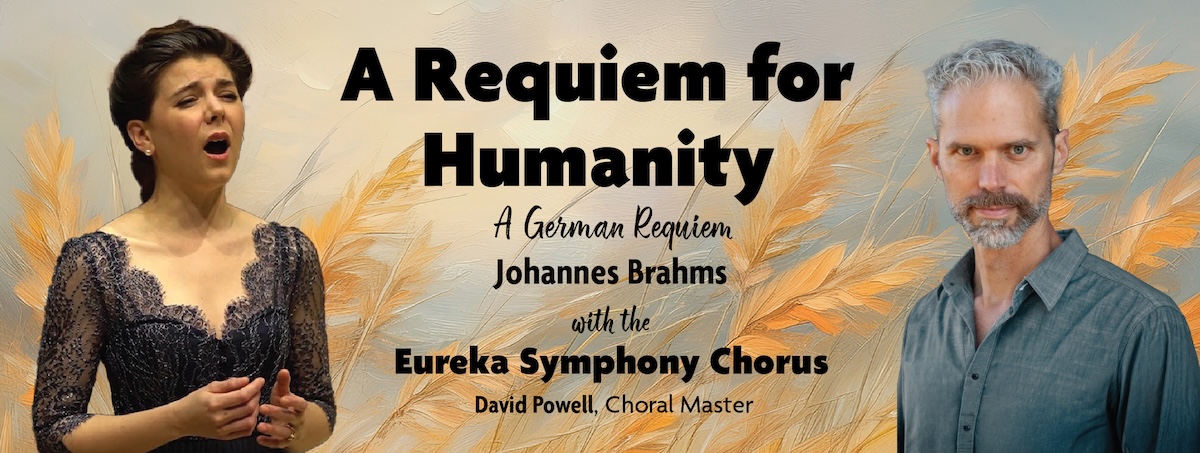
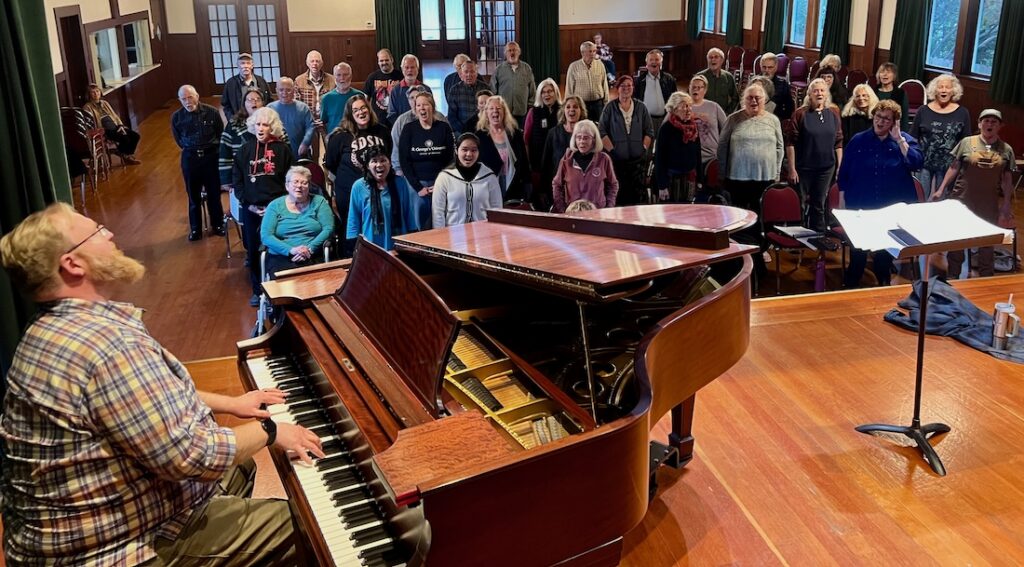
Experience the profound beauty and emotional depth of Johannes Brahms’s Ein Deutsches Requiem (A German Requiem), in an evening of reflection, remembrance and consolation. Brahms composed this luminous masterpiece not as a mass for the dead, but as a balm for the living, with music that speaks to grief, love, and the enduring human spirit. Featuring radiant soprano Lucy Fitz Gibbon and sumptuous baritone Daniel Cilli, this performance offers moments of tender intimacy and soaring grandeur. The splendid Eureka Symphony Chorus, under the leadership of Choral Master David Powell, brings Brahms’s words to heartfelt life. The chorus is composed of about 50 accomplished community members who have been rehearsing weekly since January.
With its text drawn from German scripture and its sweeping, deeply human musical language, this requiem stands as one of classical music’s most moving tributes to life, loss and the comfort we find in one another.
Tickets are from $21 to $54 and are available exclusively through the official website, www.EurekaSymphony.org, or by calling (707) 845-3655 for assistance. Be sure to purchase directly from us. There are many active third-party scams.
Families are especially welcome: with every adult ticket purchased, two children under 12 are admitted free. Special rates are also available for student groups.
For those seeking last-minute deals, RUSH tickets will be available at the door after 6 p.m. on concert evenings for just $15—or only $10 with a valid student ID. These tickets offer the best seats available and are sold on a cash-only basis.
Noted for her “dazzling, virtuoso singing” (Boston Globe), Lucy Fitz Gibbon is a dynamic musician whose repertoire spans the Renaissance to the present. She believes that creating new works and recreating those lost in centuries past makes room for the multiplicity and diversity of voices integral to classical music’s future. Ms. Fitz Gibbon has given modern premieres of rediscovered works by Baroque composers Francesco Sacrati, Barbara Strozzi, and Agostino Agazzari, as well by 20th century composers including Tadeusz Kassern, Moses Milner, and Florence Price. She also works closely with today’s composers, workshopping and premiering works by John Harbison, Katherine Balch, Kate Soper, and Pauline Oliveros, to name just a few. In helping to realize the complexities of music beyond written notes, the experience of working with these composers translates to all music: the commitment to honestly communicate not only the score, but also the underlying intentions of its creator.
A graduate of Yale University, Ms. Fitz Gibbon also holds an artist diploma from The Glenn Gould School and a master’s degree from Bard College Conservatory’s Graduate Vocal Arts Program. Her principal teachers include Monica Whicher, Edith Bers, and Dawn Upshaw. She has spent summers at the Tanglewood Music Center (2014-2015) and Marlboro Music Festival (2016-2019, 2021-2024) and serves on the faculty of Bard College Conservatory. She is honored to be a 2024 recipient of a £20,000 Fellowship Award from the Borletti-Buitoni Trust.
Daniel Cilli, baritoneDaniel’s Bio:
Baritone (he/him) performed in 2016 at the San Francisco Opera as Le Dancaïro in Carmen. Other recent highlights: Pa Zegner in Proving Up (Pasadena Opera); Burton in Sharaku Unframed premiere (Left Coast Chamber Ensemble); Captain Ladoux in Mata Hari & Snapshot programs (West Edge Opera); the title role in Sweeney Todd (Enlightened Theatrics), Cervantes/Quixote in Man of La Mancha (Cinnabar Theater); Javert in Les Miserables (Utah Festival).
He has originated roles in premieres and performed standard repertoire roles like: Le Directeur/Mr. Presto in Les mamelles de Tiresias, Billy in Mahagonny Songspiel, Thames Captain in Heart of Darkness North American premiere, title role in Gesualdo, Prince of Madness premiere (Opera Parallèle); Papageno in Die Zauberflöte (Baltimore Symphony); Dandini in La Cenerentola, Taddeo L’italiana in Algieri (Livermore Valley Opera); title role in Don Giovanni, Lescaut in Manon Lescaut (West Bay Opera); Marullo in Rigoletto (Opera Santa Barbara, Opera San Jose); Harlekin in Ariadne auf Naxos (West Edge Opera, Festival Opera); the Cellist in Death with Interruptions premiere (Left Coast Chamber Ensemble); other new works with Earplay Ensemble, SF Contemporary Music Players, and has made special appearances with the wrestlers from Oakland’s Hoodslam!
Daniel was a principal artist 2006-2010 at Opera San José and performed 15 principal roles including the title role in Eugene Onegin; Mercutio, Romeo et Juliette; Papageno, Die Zauberflöte; Dandini, La Cenerentola etc. He has also performed at Utah Opera, Des Moines Metro Opera, Utah Festival, Houston Grand Opera Studio, Central City Opera, the Tanglewood and Aspen music festivals.
I chose A German Requiem by Johannes Brahms not only for its profoundly human perspective on loss, resilience and renewal, but for the distinctive beauty of Brahms’s musical voice. Through its rich choral textures and deeply expressive lyricism, there is a unique sense of gravity and tenderness that feels both timeless and personal. It invites performers and listeners alike into a space of reflection where the music becomes a way to process grief and rediscover hope together.
Carol Jacobson, Conductor and Artistic Director
Musical Notes:
Enhance your enjoyment of Conductor Carol Jacobson’s musical selections with Musical Notes, free pre-concert talks at the Arkley at 6:30 p.m. before each concert. Hosted by Concertmaster Terrie Baune and pianist John Chernoff, often joined by special guests, the talks are an informal and informative way to learn about the composers and pieces to be played that evening. You’ll learn enthralling facts about the music and the era of each piece, and hear from guest artists who share their background and insights into the music they will perform.
There is no assigned seating for these talks, so you can be as close to the stage as you wish or experiment by sitting in different sections of the beautiful Arkley Center for the Performing Arts. Again, Musical Notes now begins at 6:30 p.m. and lasts about half an hour, leaving you time to stretch your legs and find your assigned seat before the concert begins.
Sponsored by Carol and Wayne Palmer.
Live and Local Concert Preview:
To learn more about the concert in advance, join host Elizabeth Morrison on Zoom from 6:00-7:30 p.m. on TUESDAYMay 26, (it’s on Tuesday, not Monday, before the concert this time). For details visit “Live & Local Concert Preview”, a free OLLI Special Interest Group sponsored by the Eureka Symphony.
Sponsored by the Eureka Symphony.
Shuttle:
Reserve a seat by Tuesday, May 26
Concert attendees who may need assistance getting to the concert are encouraged to sign up for the Eureka Symphony’s new door-to-door Shuttle Program, a safe and easy way to get to and from the concerts. Follow the button below or call (707) 845-3655 for details. Last minute reservations will be subject to availability and we need to stay in touch if you sign up and your plans change.
Additional notes about this concert from our Playbill
The final concert of Eureka Symphony’s season brings Ein deutsches Requiem (A German Requiem), by Johannes Brahms (1833 – 1897). Before Brahms, the Requiem, or Funeral Mass, was part of a tradition dating back as far as the second century. The text was in Latin, and while the sequence of movements was not absolutely set, there would be no surprises for the mourners who came to say their final farewells. Brahms’s German Requiem, however, is completely outside this tradition. Unlike Mozart’s Requiem in D Minor, which concluded the Eureka Symphony’s 2023-24 season, there is no dramatic Dies Irae or heartfelt Agnus Dei. Indeed, there is no Latin at all. When Brahms began to compose his requiem, not long after his mother’s death in February 1865, he chose to call it Ein deutsches Requiem, carefully distinguishing it from requiems like Mozart’s. He compiled his own text, in German, drawing mainly on the Lutheran Bible, a German translation by Martin Luther. He further explained that the “German” in the title referred to the language, not the audience; he told a colleague that he would have gladly called it Ein menschliches Requiem–a Human Requiem. His focus was not on the soul of the departed but on those left behind; his goal was not to entreat salvation for the dead but to bring comfort to the living.
At over an hour in length, with a choir and full orchestra, it is Brahms’ longest composition and his largest ensemble. In its final form it has seven movements; all are serious and inwardly spiritual, but do not invoke the specific religion of the Requiem Mass. When Karl Reinthaler, a theologically trained musician who was to conduct the premiere at the cathedral in Bremen in 1868, respectfully pointed out to Brahms that he had never gotten around to mentioning the founder of Christianity, Brahms made clear that this was exactly what he intended. He was a humanist and an agnostic, and his requiem was going to express that. However, he and Reinthaler reached a compromise. Brahms agreed to have Amalie Joachim, the wife of his colleague and concertmaster Joseph Joachim, insert the aria “I know that my Redeemer liveth,” from Handel’s Messiah, into the work’s then-existing six movements. After the premiere, recognizing that a soprano solo served his piece well, he wrote one himself, bringing the number of movements to seven. The beautiful new movement, the fifth, extends the theme of comfort, but again avoids any mention of religious dogma. The words are simple. “Thee I will comfort as one whom a mother comforts” –perhaps the ultimate in reassurance.
This is not only Brahms’s most substantial work, it is the one that finally established his reputation as a composer. It got off to a somewhat doubtful start when three of the movements were premiered in 1867, to mixed reviews. But the reception at the true premiere was all he could have wished for. He was in the midst of a painful quarrel with Clara Schumann, but she showed up for the premiere anyway and was moved to rapturous tears. Even today, as famous as it is, we can still be surprised by a requiem so full of joy. The dead, far from dominating the proceedings, are not even mentioned until the next-to-last movement, when it is noted that they will be raised, incorruptible. Freude, joy, the word at the center of Beethoven’s choral symphony, has a stronger presence than Tod, death. From the opening measures a world of beauty emerges from the depths, first from the basses and cellos, then from the divided violas. The violins do not play at all in the first movement, nor do the clarinets or the piccolo; it’s as if Brahms is holding the music low, around the heart. The chorus enters with the words “Selig sind,” blessed are they, on a rising major third that rises further to a fourth, a motif we will hear throughout. A few minutes in, the tempo quickens for the first time, and we hear Brahms’s message, one that resonates throughout this beautiful work: they that sow in tears shall reap in joy.